DIRECTED BY
Craig Mazin
YEAR
Storm Reid
2023
Lamar Johnson
Melanie Lynskey
STARRING
Pedro Pascal
Bella Ramsey
Anna Torv
Nico Parker
Gabriel Luna
Merle Dandridge
The eighth episode of The Last of Us is not simply a high point of narrative tension — it is a visual and neurophysiological masterclass in psychological compression.
While the script delivers fear and intimacy, it’s the color and composition that calibrate threat, agency, and moral entropy directly into the viewer’s nervous system.
At Digital NeuroLab, we analyze media through a neurocognitive framework — assessing how shot structure, luminance, saturation, and spatial compression modulate viewer arousal, empathy, and attentional fixation.
Episode 8 demonstrates an elite command of cortical choreography, especially in its color temperature control, visual asymmetry, and depth modulation.
Composition as Psychological Pressure
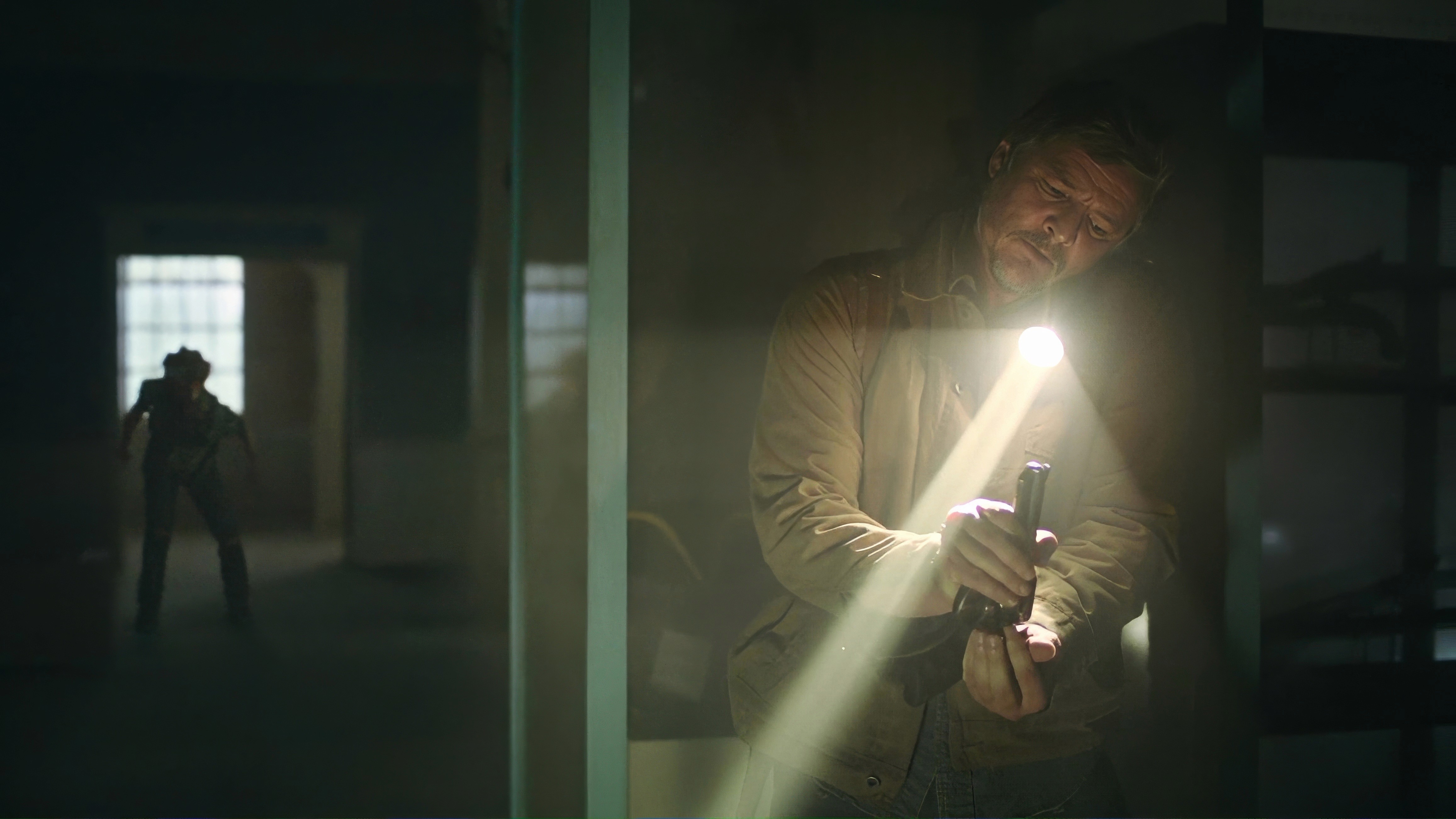
This episode relies on constrained geometries — narrow cabins, off-axis eye lines, and aggressive foregrounding — all of which activate the spatial threat network in the brain. According to Tversky et al. (2009), compressed depth and oblique symmetry elevate the activity of the amygdala and dorsal anterior insula, simulating a loss of escape vector.
Notably, the mise-en-scène is engineered with:
Central occlusions (objects partially obscuring faces or paths) — triggering defensive visual scanning behavior.
Reverse-shot imbalance — where the antagonist is consistently framed with more negative space, creating a power asymmetry the brain registers as dominance.
Low-focal depth close-ups — producing retinal blur outside of foveal vision, increasing sympathetic tension (EDA↑, HR↑).
What results is not cinematic composition, but sensorimotor claustrophobia. The frame doesn’t show — it traps.
Chromatic Tension: Blue Fire and Rot
The palette of Episode 8 is a controlled contradiction: frozen blues and fungal browns. It’s not just aesthetic — it’s neuroaffective priming.
We observe:
Cold steel blues and desaturated whites dominate the external shots → activate hypometabolic states, suppressing reward anticipation and simulating fatigue (see: Lichter et al., 2010).
Sudden warm glows (firelight, blood, eyes) appear only in moments of threat or climax → creating dopaminergic spikes precisely when narrative action peaks.
From a neurocinematic standpoint, this is episodic entrainment: the viewer’s baseline is numbed, then punctured by calibrated chromatic arousal bursts.
This contrast is critical for maintaining tension without exhausting the viewer — a strategy we call cognitive oxygen deprivation with rhythmic spikes.
Facial Framing and Face Bias Violation
One of the most effective strategies in Episode 8 is its disruption of face bias. Normally, the brain prioritizes symmetrical, well-lit faces (Kanwisher, 1997), but this episode frequently violates that expectation:
Underlit close-ups with non-central gaze delay FFA recognition.
Profiles with auditory tension (offscreen sound) stimulate anticipatory threat processing in the lateral amygdala.
Eye contact breaks mid-frame — shifting engagement from empathy to analysis, forcing the viewer into an observer stance (see: Frith & Frith, 2006).
The result: you don't watch the scene — you scan it.
Firelight as Archetypal Catharsis
The burning cabin sequence is not just climactic. It is mythologically encoded.
Ellie and David are lit almost entirely by flame — a reversion to primal ritual aesthetics.
Faces flicker between light and shadow, encoding both the hero's ordeal and the destruction of the predator archetype.
The background dissolves into visual noise (blacks, oranges, chromatic aberration) — simulating cortical overload, as if the frame itself loses structure.
According to Campbellian mapping, this moment is not revenge. It is ritual purification — made visible through color frequency and retinal destabilization.
Key Lessons for Cinematic Creators
Episode 8 of The Last of Us illustrates how visual syntax can displace narrative exposition.
If you're building tension-heavy media, study how this episode:
Uses asymmetric framing to create unconscious power hierarchies
Deploys color deprivation followed by chromatic violence to drive retention
Violates face perception norms to trigger pre-attentive alertness
Balances narrative withholding with sensory flooding for emotional catharsis
Grounds the climax in archetypal encoding, not exposition
DIRECTED BY
YEAR
2023
STARRING
Pedro Pascal
Gabriel Luna
Bella Ramsey
Lukas Gage
Shalita Grant
Dylan Arnold
Nico Parker
Anna Torv
Craig Mazin
The eighth episode of The Last of Us is not simply a high point of narrative tension — it is a visual and neurophysiological masterclass in psychological compression.
While the script delivers fear and intimacy, it’s the color and composition that calibrate threat, agency, and moral entropy directly into the viewer’s nervous system.
At Digital NeuroLab, we analyze media through a neurocognitive framework — assessing how shot structure, luminance, saturation, and spatial compression modulate viewer arousal, empathy, and attentional fixation.
Episode 8 demonstrates an elite command of cortical choreography, especially in its color temperature control, visual asymmetry, and depth modulation.
Composition as Psychological Pressure
This episode relies on constrained geometries — narrow cabins, off-axis eye lines, and aggressive foregrounding — all of which activate the spatial threat network in the brain. According to Tversky et al. (2009), compressed depth and oblique symmetry elevate the activity of the amygdala and dorsal anterior insula, simulating a loss of escape vector.
Notably, the mise-en-scène is engineered with:
Central occlusions (objects partially obscuring faces or paths) — triggering defensive visual scanning behavior.
Reverse-shot imbalance — where the antagonist is consistently framed with more negative space, creating a power asymmetry the brain registers as dominance.
Low-focal depth close-ups — producing retinal blur outside of foveal vision, increasing sympathetic tension (EDA↑, HR↑).
What results is not cinematic composition, but sensorimotor claustrophobia. The frame doesn’t show — it traps.
Chromatic Tension: Blue Fire and Rot
The palette of Episode 8 is a controlled contradiction: frozen blues and fungal browns. It’s not just aesthetic — it’s neuroaffective priming.
We observe:
Cold steel blues and desaturated whites dominate the external shots → activate hypometabolic states, suppressing reward anticipation and simulating fatigue (see: Lichter et al., 2010).
Sudden warm glows (firelight, blood, eyes) appear only in moments of threat or climax → creating dopaminergic spikes precisely when narrative action peaks.
From a neurocinematic standpoint, this is episodic entrainment: the viewer’s baseline is numbed, then punctured by calibrated chromatic arousal bursts.
This contrast is critical for maintaining tension without exhausting the viewer — a strategy we call cognitive oxygen deprivation with rhythmic spikes.
Facial Framing and Face Bias Violation
One of the most effective strategies in Episode 8 is its disruption of face bias. Normally, the brain prioritizes symmetrical, well-lit faces (Kanwisher, 1997), but this episode frequently violates that expectation:
Underlit close-ups with non-central gaze delay FFA recognition.
Profiles with auditory tension (offscreen sound) stimulate anticipatory threat processing in the lateral amygdala.
Eye contact breaks mid-frame — shifting engagement from empathy to analysis, forcing the viewer into an observer stance (see: Frith & Frith, 2006).
The result: you don't watch the scene — you scan it.
Firelight as Archetypal Catharsis
The burning cabin sequence is not just climactic. It is mythologically encoded.
Ellie and David are lit almost entirely by flame — a reversion to primal ritual aesthetics.
Faces flicker between light and shadow, encoding both the hero's ordeal and the destruction of the predator archetype.
The background dissolves into visual noise (blacks, oranges, chromatic aberration) — simulating cortical overload, as if the frame itself loses structure.
According to Campbellian mapping, this moment is not revenge. It is ritual purification — made visible through color frequency and retinal destabilization.
Key Lessons for Cinematic Creators
Episode 8 of The Last of Us illustrates how visual syntax can displace narrative exposition.
If you're building tension-heavy media, study how this episode:
Uses asymmetric framing to create unconscious power hierarchies
Deploys color deprivation followed by chromatic violence to drive retention
Violates face perception norms to trigger pre-attentive alertness
Balances narrative withholding with sensory flooding for emotional catharsis
Grounds the climax in archetypal encoding, not exposition
DIGITAL NEUROLAB

Disclaimer on Brand Mentions and Logos. At Digital NeuroLab,
we research how human attention responds to various forms
of visual and narrative content across the media landscape.
The companies and brands featured on this website represent
benchmarks in content strategy, storytelling, and audience
engagement. We do not claim any formal partnership
or commercial relationship with these organizations unless
explicitly stated. Their logos are included solely to illustrate
the level and type of content our neuro-models are designed
to analyze and optimize for. This representation reflects our
research motivation and industry alignment — not an endorsement,
affiliation, or implication of collaboration. Digital NeuroLab operates
as a scientific and strategic attention lab.
We openly study best-in-class media ecosystems to develop
frameworks that help our clients create content with measurable
cognitive and emotional impact. Referencing leading brands is part
of our transparent benchmarking process — not a marketing tactic.
Our standards are shaped by what performs at the frontier of
perception, and we make no apologies for setting the bar high.
WANT MORE DIGITAL NEUROLAB?
Legal Information
User Agreement
Offer Agreement
Personal Data Processing Policy
Cookie Policy
Consumer Rights Protection Policy
Payment and Security Policy
Company Legal Information
IP Policy
© 2025 Digital NeuroLab Inc. All rights reserved.
Digital NeuroLab Inc. is a Delaware-registered scientific
consultancy specializing in attention and neuro-behavioral modeling.
Registered office: 126192 Coastal Highway, in the city of Lewes, Delaware 19801, USA.
Operating globally — United States · European Union.
Tax ID (EIN): 38-9215473 | Email: contact@digitalneurolab.io
DIGITAL
NEUROLAB
Disclaimer on Brand Mentions and Logos. At Digital NeuroLab, we research how human attention responds to various forms of visual and narrative content across the media landscape. The companies and brands featured on this website represent benchmarks in content strategy, storytelling, and audience engagement. We do not claim any formal partnership or commercial relationship with these organizations unless explicitly stated. Their logos are included solely to illustrate the level and type of content our neuro-models are designed to analyze and optimize for. This representation reflects our research motivation and industry alignment — not an endorsement, affiliation, or implication of collaboration. Digital NeuroLab operates as a scientific and strategic attention lab. We openly study best-in-class media ecosystems to develop frameworks that help our clients create content with measurable cognitive and emotional impact. Referencing leading brands is part of our transparent benchmarking process — not a marketing tactic. Our standards are shaped by what performs at the frontier of perception, and we make no apologies for setting the bar high.
WANT MORE DIGITAL NEUROLAB?
Legal Information
User Agreement
Offer Agreement
Personal Data Processing Policy
Cookie Policy
Consumer Rights Protection Policy
Payment and Security Policy
Company Legal Information
IP Policy
© 2025 Digital NeuroLab Inc. All rights reserved.
Digital NeuroLab Inc. is a Delaware-registered scientific consultancy specializing in attention and neuro-behavioral modeling.
Registered office: 126192 Coastal Highway, in the city of Lewes, Delaware 19801, USA.
Operating globally — United States · European Union.
Tax ID (EIN): 38-9215473 | Email: contact@digitalneurolab.io