Analysis
Daniel Schiffer
Subnails
MENU

Analysis
Daniel Schiffer
Subnails
MENU
Daniel Schiffer is a Canadian filmmaker and creative entrepreneur best known for revolutionizing the online video editing and filmmaking tutorial space with his ultra-cinematic b-roll sequences, DIY filmmaking hacks, and high-end commercial visuals — often shot using budget gear.
DESCRIPTION
CREATIVE TEAM
• Created by: Daniel Schiffer
• Lead Roles:
• Daniel Schiffer — director, cinematographer, editor, colorist, on-camera educator
• Occasional collaboration with other creators (e.g., Chris Hau, Peter McKinnon)
• Executive Oversight: Independent / Self-run
• Production Style:
• Solo-filmed and edited, often with run-and-gun gear setups
• Heavy use of manual focus, macro lenses, whip transitions, and hyperreal food cinematography
• Filming Equipment:
• Canon EOS R5 / Sony A7S III (varies by year)
• High-end macro lenses (e.g., Laowa 100mm)
• Gimbals, sliders, custom rigs for motion
FORMAT & CONTENT STRUCTURE
• Genres:
• Cinematic B-roll Tutorials
• Behind-the-Scenes (BTS) of Commercial Shoots
• Filmmaking & Editing Techniques
• Gear Reviews & Camera Setup Guides
• Visual Signature:
• Ultra-smooth B-roll with whip pans, macro close-ups, and high-speed transitions
• Dynamic lighting, fast-paced editing synced to music
• Food and product cinematography with shallow depth of field and vibrant contrast
• Narrative Flow per Video:
1. Hook (0–10s): High-energy B-roll sequence
2. Breakdown (10s–2min): Quick walkthrough of tools or technique
3. Tutorial or BTS (2–7min): Step-by-step explanation of shots
4. Closing insights / call to action
• Genre Tags:
• Crime thriller
• Neo-noir
• Journalistic fiction
• Cross-cultural narrative
• Institutional psychology
Title: Daniel Schiffer
Format: Filmmaking / Cinematic Content Creator
Platform: YouTube
Years Active: 2015–present
Subscribers: ~2.5 million (as of 2025)
Typical Video Length: 6–15 minutes
Language: English
Country of Origin: Canada
Daniel Schiffer is not just a filmmaker. He is a thumbnail tactician, an architect of pre-attentive engagement.
His videos don’t simply get clicked — they’re pre-decided by the viewer’s nervous system before cognition even arrives.
At Digital NeuroLab, we study why. And we can state plainly: Daniel’s thumbnails are a masterclass in neurovisual architecture.
Visual Entrapment: The Thumbnail as Cortical Trojan Horse
Daniel Schiffer’s thumbnails routinely generate CTR levels approaching 20% — an anomaly in long-form, non-clickbait content.
This is not luck. It is visual engineering.
Each thumbnail is not an image. It is a compression algorithm for attention — designed to hijack the viewer’s dorsal attention network (DAN) in under 80 milliseconds.
And it works — because it follows every major neurovisual law.
Neurodesign Principles at Play
1. High Local Contrast + Chromatic Anchoring
Daniel isolates subjects (hand, object, food, gear) with surgical lighting and background suppression, generating retinal saliency gradients that mimic foveal fixation.
He often uses complementary color pairs — orange & teal, blue & amber — to spike visual cortex V1–V4 response curves (Livingstone & Hubel, 1988).
2. Fractal Symmetry & Centered Tension
His thumbnails are not chaotic. They follow midline symmetry or rule-of-thirds gravitational balance, offering fluency bias (Reber et al., 2004), which makes the image feel correct before it is even parsed.
Even when elements break symmetry (e.g. splash, blur), they obey the Gestalt law of common fate — everything moves in alignment.
3. Motion Without Motion
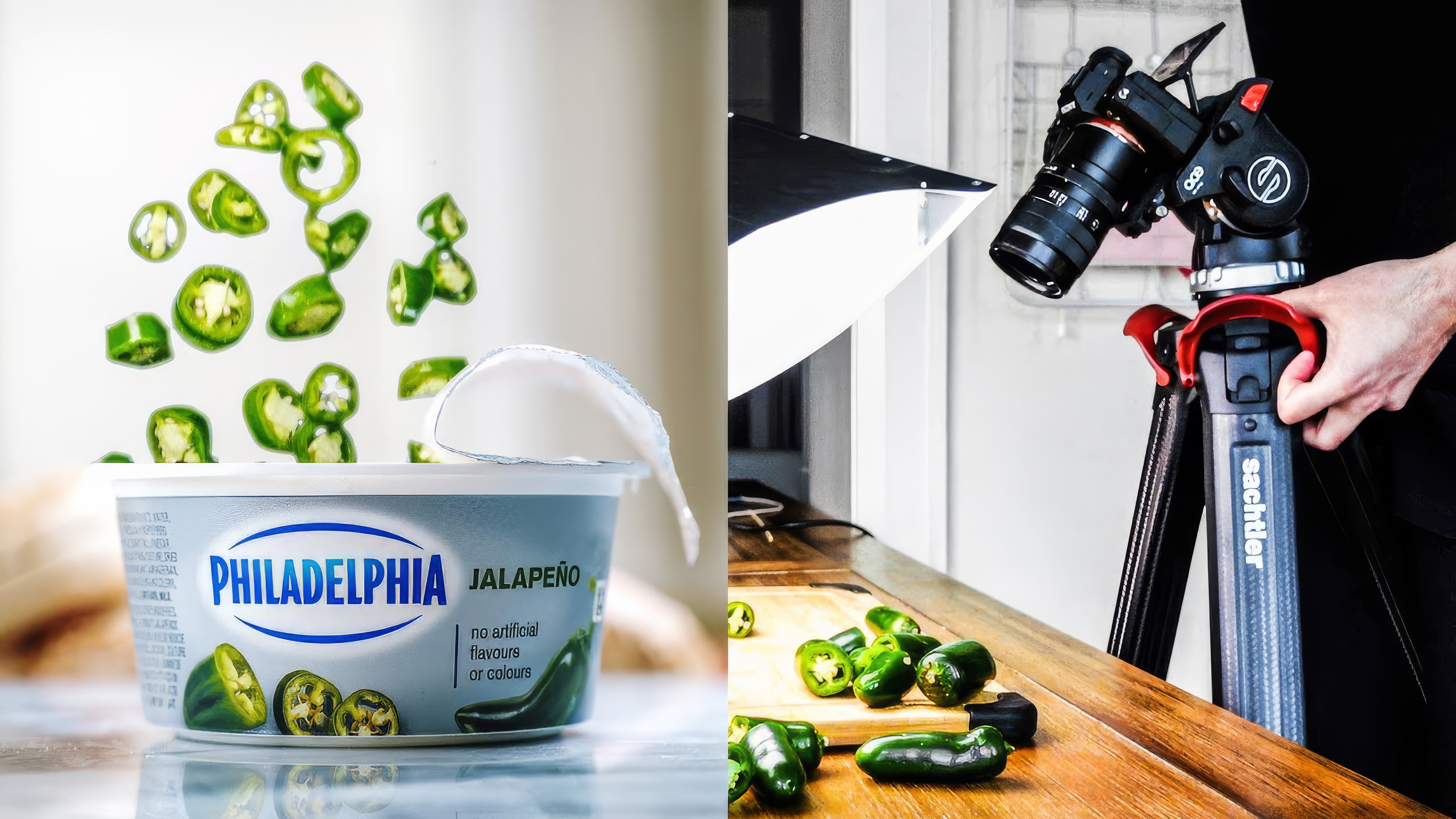
Schiffer uses visual blur, object splash, or fine-particulate texture to create the illusion of movement within a still frame — activating motion-sensitive MT+ neurons, creating a pseudo-cinematic draw.
It feels like the frame is breathing. This lures in the SC (superior colliculus) — the brainstem’s attentional sniper.
4. The Icon Effect: Tool-as-Archetype
Whether it's a knife slicing a tomato, a lens dropping on a table, or coffee grains suspended mid-air, he captures not the object — but the ritual around it.
This activates tool association centers in the premotor cortex (Rizzolatti et al., 1996), generating subconscious action mirroring and sensorimotor empathy.
Color as Cortical Currency
Daniel doesn’t guess his palette — he constructs it.
Each thumbnail contains a deliberate balance of:
Warm aggression (reds, oranges) → spike HR, approach behavior
Cool contrast (blues, cyans) → reduce threat perception, soften the edge
Natural saturation → avoids cognitive overload while preserving pop
His lighting is not aesthetic. It’s dopaminergic framing.
Why This Works: A Neurocommerce View
In a world flooded with thumbnails, the average CTR across YouTube sits around 4–6%.
Daniel consistently achieves 3–4x the baseline.
Why?
Because he is Daniel.
CREATIVE TEAM
• Created by: Daniel Schiffer
• Lead Roles:
• Daniel Schiffer — director, cinematographer, editor, colorist, on-camera educator
• Occasional collaboration with other creators (e.g., Chris Hau, Peter McKinnon)
• Executive Oversight: Independent / Self-run
• Production Style:
• Solo-filmed and edited, often with run-and-gun gear setups
• Heavy use of manual focus, macro lenses, whip transitions, and hyperreal food cinematography
• Filming Equipment:
• Canon EOS R5 / Sony A7S III (varies by year)
• High-end macro lenses (e.g., Laowa 100mm)
• Gimbals, sliders, custom rigs for motion
FORMAT & CONTENT STRUCTURE
• Genres:
• Cinematic B-roll Tutorials
• Behind-the-Scenes (BTS) of Commercial Shoots
• Filmmaking & Editing Techniques
• Gear Reviews & Camera Setup Guides
• Visual Signature:
• Ultra-smooth B-roll with whip pans, macro close-ups, and high-speed transitions
• Dynamic lighting, fast-paced editing synced to music
• Food and product cinematography with shallow depth of field and vibrant contrast
• Narrative Flow per Video:
1. Hook (0–10s): High-energy B-roll sequence
2. Breakdown (10s–2min): Quick walkthrough of tools or technique
3. Tutorial or BTS (2–7min): Step-by-step explanation of shots
4. Closing insights / call to action
• Genre Tags:
• Crime thriller
• Neo-noir
• Journalistic fiction
• Cross-cultural narrative
• Institutional psychology
Daniel Schiffer is not just a filmmaker. He is a thumbnail tactician, an architect of pre-attentive engagement.
His videos don’t simply get clicked — they’re pre-decided by the viewer’s nervous system before cognition even arrives.
At Digital NeuroLab, we study why. And we can state plainly: Daniel’s thumbnails are a masterclass in neurovisual architecture.
Visual Entrapment: The Thumbnail as Cortical Trojan Horse
Daniel Schiffer’s thumbnails routinely generate CTR levels approaching 20% — an anomaly in long-form, non-clickbait content.
This is not luck. It is visual engineering.
Each thumbnail is not an image. It is a compression algorithm for attention — designed to hijack the viewer’s dorsal attention network (DAN) in under 80 milliseconds.
And it works — because it follows every major neurovisual law.
Neurodesign Principles at Play
1. High Local Contrast + Chromatic Anchoring
Daniel isolates subjects (hand, object, food, gear) with surgical lighting and background suppression, generating retinal saliency gradients that mimic foveal fixation.
He often uses complementary color pairs — orange & teal, blue & amber — to spike visual cortex V1–V4 response curves (Livingstone & Hubel, 1988).
2. Fractal Symmetry & Centered Tension
His thumbnails are not chaotic. They follow midline symmetry or rule-of-thirds gravitational balance, offering fluency bias (Reber et al., 2004), which makes the image feel correct before it is even parsed.
Even when elements break symmetry (e.g. splash, blur), they obey the Gestalt law of common fate — everything moves in alignment.
3. Motion Without Motion
Schiffer uses visual blur, object splash, or fine-particulate texture to create the illusion of movement within a still frame — activating motion-sensitive MT+ neurons, creating a pseudo-cinematic draw.
It feels like the frame is breathing. This lures in the SC (superior colliculus) — the brainstem’s attentional sniper.
4. The Icon Effect: Tool-as-Archetype
Whether it's a knife slicing a tomato, a lens dropping on a table, or coffee grains suspended mid-air, he captures not the object — but the ritual around it.
This activates tool association centers in the premotor cortex (Rizzolatti et al., 1996), generating subconscious action mirroring and sensorimotor empathy.
Color as Cortical Currency
Daniel doesn’t guess his palette — he constructs it.
Each thumbnail contains a deliberate balance of:
Warm aggression (reds, oranges) → spike HR, approach behavior
Cool contrast (blues, cyans) → reduce threat perception, soften the edge
Natural saturation → avoids cognitive overload while preserving pop
His lighting is not aesthetic. It’s dopaminergic framing.
Why This Works: A Neurocommerce View
In a world flooded with thumbnails, the average CTR across YouTube sits around 4–6%.
Daniel consistently achieves 3–4x the baseline.
Why?
Because he is Daniel.
Daniel Schiffer is a Canadian filmmaker and creative entrepreneur best known for revolutionizing the online video editing and filmmaking tutorial space with his ultra-cinematic b-roll sequences, DIY filmmaking hacks, and high-end commercial visuals — often shot using budget gear.
DESCRIPTION
Title: Daniel Schiffer
Format: Filmmaking / Cinematic Content Creator
Platform: YouTube
Years Active: 2015–present
Subscribers: ~2.5 million (as of 2025)
Typical Video Length: 6–15 minutes
Language: English
Country of Origin: Canada
DIGITAL NEUROLAB

Disclaimer on Brand Mentions and Logos. At Digital NeuroLab,
we research how human attention responds to various forms
of visual and narrative content across the media landscape.
The companies and brands featured on this website represent
benchmarks in content strategy, storytelling, and audience
engagement. We do not claim any formal partnership
or commercial relationship with these organizations unless
explicitly stated. Their logos are included solely to illustrate
the level and type of content our neuro-models are designed
to analyze and optimize for. This representation reflects our
research motivation and industry alignment — not an endorsement,
affiliation, or implication of collaboration. Digital NeuroLab operates
as a scientific and strategic attention lab.
We openly study best-in-class media ecosystems to develop
frameworks that help our clients create content with measurable
cognitive and emotional impact. Referencing leading brands is part
of our transparent benchmarking process — not a marketing tactic.
Our standards are shaped by what performs at the frontier of
perception, and we make no apologies for setting the bar high.
WANT MORE DIGITAL NEUROLAB?
Legal Information
User Agreement
Offer Agreement
Personal Data Processing Policy
Cookie Policy
Consumer Rights Protection Policy
Payment and Security Policy
Company Legal Information
IP Policy
© 2025 Digital NeuroLab Inc. All rights reserved.
Digital NeuroLab Inc. is a Delaware-registered scientific
consultancy specializing in attention and neuro-behavioral modeling.
Registered office: 126192 Coastal Highway, in the city of Lewes, Delaware 19801, USA.
Operating globally — United States · European Union.
Tax ID (EIN): 38-9215473 | Email: contact@digitalneurolab.io
DIGITAL
NEUROLAB
Disclaimer on Brand Mentions and Logos. At Digital NeuroLab, we research how human attention responds to various forms of visual and narrative content across the media landscape. The companies and brands featured on this website represent benchmarks in content strategy, storytelling, and audience engagement. We do not claim any formal partnership or commercial relationship with these organizations unless explicitly stated. Their logos are included solely to illustrate the level and type of content our neuro-models are designed to analyze and optimize for. This representation reflects our research motivation and industry alignment — not an endorsement, affiliation, or implication of collaboration. Digital NeuroLab operates as a scientific and strategic attention lab. We openly study best-in-class media ecosystems to develop frameworks that help our clients create content with measurable cognitive and emotional impact. Referencing leading brands is part of our transparent benchmarking process — not a marketing tactic. Our standards are shaped by what performs at the frontier of perception, and we make no apologies for setting the bar high.
WANT MORE DIGITAL NEUROLAB?
Legal Information
User Agreement
Offer Agreement
Personal Data Processing Policy
Cookie Policy
Consumer Rights Protection Policy
Payment and Security Policy
Company Legal Information
IP Policy
© 2025 Digital NeuroLab Inc. All rights reserved.
Digital NeuroLab Inc. is a Delaware-registered scientific consultancy specializing in attention and neuro-behavioral modeling.
Registered office: 126192 Coastal Highway, in the city of Lewes, Delaware 19801, USA.
Operating globally — United States · European Union.
Tax ID (EIN): 38-9215473 | Email: contact@digitalneurolab.io