
DIRECTED BY
Lee Sung Jin
YEAR
2023
STARRING
Ashley Park
Steven Yeun
Ali Wong
Joseph Lee
Young Mazino
David Choe
Patti Yasutake
Mia Serafino
Remy Holt
Beef is not just a show — it is an empathic neural trigger system disguised as narrative television.
What makes it remarkable is not merely the sharpness of its dialogue or the escalation of conflict, but its ability to evoke intense identification with emotional pain most viewers have never directly experienced. That is not a literary accomplishment — it is a neurophysiological precision strike.
At Digital NeuroLab, we evaluate content based on its capacity to generate subcortical engagement, bypassing rational analysis and activating shared somatic memory. Beef achieves this by combining an architecturally brilliant script with deeply tuned visual and auditory design — calibrated not to represent pain, but to simulate the contours of unresolved inner tension.
Neuro-Affective Story Design
The script of Beef does not aim for relatability in the conventional sense.
It presents irrational outbursts, fractured pride, inherited shame — emotions that are foreign in form, but familiar in frequency.
This is what we call cross-contextual emotional mapping: the ability of a story to transpose a viewer’s unrelated experiences onto a character’s distinct crisis.
This is achieved through:
Delayed exposition — preventing early narrative alignment and triggering active projection.
Dialogic vacuums — scenes where characters speak around the truth, activating mirror neuron systems through implied emotion.
Pacing entropy — sudden accelerations or delays in tension curve that replicate dysregulated nervous system states.
The result: we don’t just watch conflict — we feel the misfiring of emotional circuitry.
Visual Psychology: Subtle Chaos, Spatial Threat
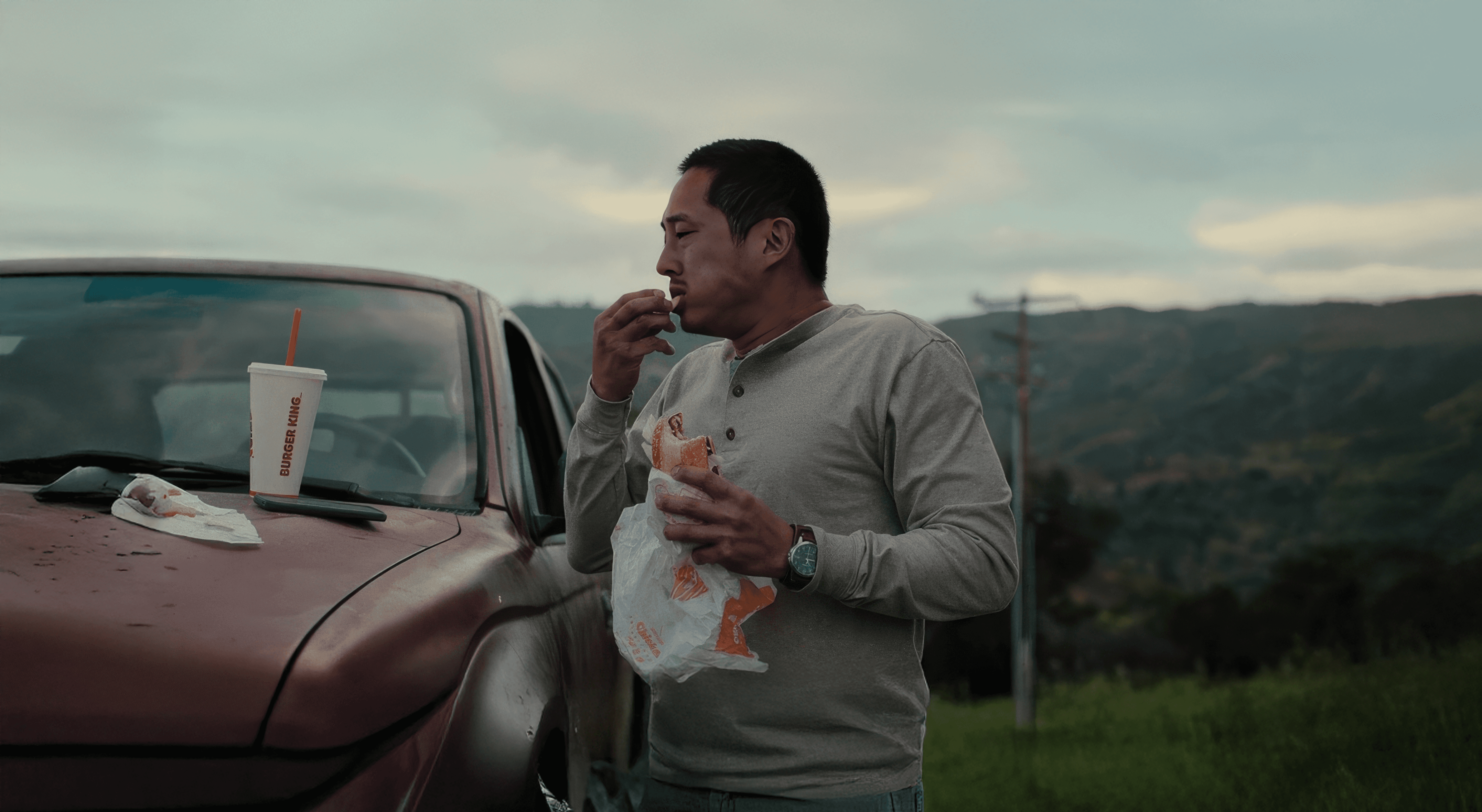
Beef employs a visual palette of controlled unease. Every frame is subtly asymmetrical, yet composed — creating a background tension field that heightens viewer vigilance without overt chaos.
Visual strategies include:
Low-angle proximity shots → stimulate sensorimotor alertness, mimicking confrontation (peripersonal threat network).
Muted saturation with punctuated warmth → elicits limbic ambiguity, keeping the brain uncertain whether to relax or brace.
Persistent eye-line distortion → disorients gaze-following circuits, making empathy feel effortful, not automatic.
These are not aesthetic choices. They are neural architectures of conflict.
Auditory Engineering: Trauma-Rhythm Calibration
The sound design is equally refined. Ambient sounds are compressive, creating a sense of spatial suffocation. Diegetic audio often overrides score — grounding the narrative in real-time nervous system fidelity.
Key techniques include:
Environmental noise continuity → activates auditory attention anchoring, preventing viewer detachment.
Low-frequency pulses in transitional scenes → stimulate hippocampal anxiety encoding, reinforcing memory of emotionally volatile moments.
Microdissonance in ambient sound layers → keeps amygdalar threat activation subtly elevated.
The net result is limbic stickiness: scenes that linger not because they were loud — but because they were sensorially unresolved.
Archetypal Pain, Personalized
At the story's core lie fragmented archetypes — not heroic nor villainous, but broken in highly specific ways.
The humiliated provider, the ungrateful child, the parentified partner, the person who got everything but feels nothing.
These figures bypass plot logic and tap into inherited emotion grammars, stored across cultures, families, and traumas.
That’s why we feel them — even when we’ve never lived them.
Neurocinematic Lessons
Beef is a textbook in multi-modal narrative entrainment. If you're building high-retention content, learn from this structure:
Don’t chase relatability — chase resonance.
Design your visual field for unspoken stress, not just composition.
Engineer sound to disrupt, not just support.
Let character pain vibrate, not explain.
This is not content for entertainment.
It is narrative neuroinjection — subtle, smart, and surgical.
For Digital NeuroLab, Beef sets a benchmark in how neurophysiology can elevate screenwriting beyond empathy — into emotional embodiment.
It doesn’t just tell a story.
It reconstructs your nervous system to feel it — as if it was yours.
DIRECTED BY
YEAR
2023
STARRING
Steven Yeun
David Choe
Ali Wong
Lukas Gage
Shalita Grant
Dylan Arnold
Young Mazino
Joseph Lee
Lee Sung Jin
Beef is not just a show — it is an empathic neural trigger system disguised as narrative television.
What makes it remarkable is not merely the sharpness of its dialogue or the escalation of conflict, but its ability to evoke intense identification with emotional pain most viewers have never directly experienced. That is not a literary accomplishment — it is a neurophysiological precision strike.
At Digital NeuroLab, we evaluate content based on its capacity to generate subcortical engagement, bypassing rational analysis and activating shared somatic memory. Beef achieves this by combining an architecturally brilliant script with deeply tuned visual and auditory design — calibrated not to represent pain, but to simulate the contours of unresolved inner tension.
Neuro-Affective Story Design
The script of Beef does not aim for relatability in the conventional sense.
It presents irrational outbursts, fractured pride, inherited shame — emotions that are foreign in form, but familiar in frequency.
This is what we call cross-contextual emotional mapping: the ability of a story to transpose a viewer’s unrelated experiences onto a character’s distinct crisis.
This is achieved through:
Delayed exposition — preventing early narrative alignment and triggering active projection.
Dialogic vacuums — scenes where characters speak around the truth, activating mirror neuron systems through implied emotion.
Pacing entropy — sudden accelerations or delays in tension curve that replicate dysregulated nervous system states.
The result: we don’t just watch conflict — we feel the misfiring of emotional circuitry.
Visual Psychology: Subtle Chaos, Spatial Threat
Beef employs a visual palette of controlled unease. Every frame is subtly asymmetrical, yet composed — creating a background tension field that heightens viewer vigilance without overt chaos.
Visual strategies include:
Low-angle proximity shots → stimulate sensorimotor alertness, mimicking confrontation (peripersonal threat network).
Muted saturation with punctuated warmth → elicits limbic ambiguity, keeping the brain uncertain whether to relax or brace.
Persistent eye-line distortion → disorients gaze-following circuits, making empathy feel effortful, not automatic.
These are not aesthetic choices. They are neural architectures of conflict.
Auditory Engineering: Trauma-Rhythm Calibration
The sound design is equally refined. Ambient sounds are compressive, creating a sense of spatial suffocation. Diegetic audio often overrides score — grounding the narrative in real-time nervous system fidelity.
Key techniques include:
Environmental noise continuity → activates auditory attention anchoring, preventing viewer detachment.
Low-frequency pulses in transitional scenes → stimulate hippocampal anxiety encoding, reinforcing memory of emotionally volatile moments.
Microdissonance in ambient sound layers → keeps amygdalar threat activation subtly elevated.
The net result is limbic stickiness: scenes that linger not because they were loud — but because they were sensorially unresolved.
Archetypal Pain, Personalized
At the story's core lie fragmented archetypes — not heroic nor villainous, but broken in highly specific ways.
The humiliated provider, the ungrateful child, the parentified partner, the person who got everything but feels nothing.
These figures bypass plot logic and tap into inherited emotion grammars, stored across cultures, families, and traumas.
That’s why we feel them — even when we’ve never lived them.
Neurocinematic Lessons
Beef is a textbook in multi-modal narrative entrainment. If you're building high-retention content, learn from this structure:
Don’t chase relatability — chase resonance.
Design your visual field for unspoken stress, not just composition.
Engineer sound to disrupt, not just support.
Let character pain vibrate, not explain.
This is not content for entertainment.
It is narrative neuroinjection — subtle, smart, and surgical.
For Digital NeuroLab, Beef sets a benchmark in how neurophysiology can elevate screenwriting beyond empathy — into emotional embodiment.
It doesn’t just tell a story.
It reconstructs your nervous system to feel it — as if it was yours.
DIGITAL NEUROLAB

Disclaimer on Brand Mentions and Logos. At Digital NeuroLab,
we research how human attention responds to various forms
of visual and narrative content across the media landscape.
The companies and brands featured on this website represent
benchmarks in content strategy, storytelling, and audience
engagement. We do not claim any formal partnership
or commercial relationship with these organizations unless
explicitly stated. Their logos are included solely to illustrate
the level and type of content our neuro-models are designed
to analyze and optimize for. This representation reflects our
research motivation and industry alignment — not an endorsement,
affiliation, or implication of collaboration. Digital NeuroLab operates
as a scientific and strategic attention lab.
We openly study best-in-class media ecosystems to develop
frameworks that help our clients create content with measurable
cognitive and emotional impact. Referencing leading brands is part
of our transparent benchmarking process — not a marketing tactic.
Our standards are shaped by what performs at the frontier of
perception, and we make no apologies for setting the bar high.
WANT MORE DIGITAL NEUROLAB?
Legal Information
User Agreement
Offer Agreement
Personal Data Processing Policy
Cookie Policy
Consumer Rights Protection Policy
Payment and Security Policy
Company Legal Information
IP Policy
© 2025 Digital NeuroLab Inc. All rights reserved.
Digital NeuroLab Inc. is a Delaware-registered scientific
consultancy specializing in attention and neuro-behavioral modeling.
Registered office: 126192 Coastal Highway, in the city of Lewes, Delaware 19801, USA.
Operating globally — United States · European Union.
Tax ID (EIN): 38-9215473 | Email: contact@digitalneurolab.io
DIGITAL
NEUROLAB
Disclaimer on Brand Mentions and Logos. At Digital NeuroLab, we research how human attention responds to various forms of visual and narrative content across the media landscape. The companies and brands featured on this website represent benchmarks in content strategy, storytelling, and audience engagement. We do not claim any formal partnership or commercial relationship with these organizations unless explicitly stated. Their logos are included solely to illustrate the level and type of content our neuro-models are designed to analyze and optimize for. This representation reflects our research motivation and industry alignment — not an endorsement, affiliation, or implication of collaboration. Digital NeuroLab operates as a scientific and strategic attention lab. We openly study best-in-class media ecosystems to develop frameworks that help our clients create content with measurable cognitive and emotional impact. Referencing leading brands is part of our transparent benchmarking process — not a marketing tactic. Our standards are shaped by what performs at the frontier of perception, and we make no apologies for setting the bar high.
WANT MORE DIGITAL NEUROLAB?
Legal Information
User Agreement
Offer Agreement
Personal Data Processing Policy
Cookie Policy
Consumer Rights Protection Policy
Payment and Security Policy
Company Legal Information
IP Policy
© 2025 Digital NeuroLab Inc. All rights reserved.
Digital NeuroLab Inc. is a Delaware-registered scientific consultancy specializing in attention and neuro-behavioral modeling.
Registered office: 126192 Coastal Highway, in the city of Lewes, Delaware 19801, USA.
Operating globally — United States · European Union.
Tax ID (EIN): 38-9215473 | Email: contact@digitalneurolab.io